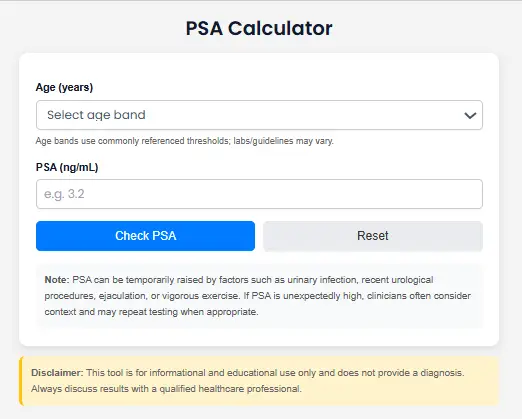
PSA (prostate-specific antigen) is a blood test used across screening, risk assessment, and follow-up. Our page above gives you a clean, distraction-free PSA calculator to record and format your PSA result, plus quick links to related tools.
What the PSA Calculator Does (and What It Doesn’t)
- Displays your PSA value (ng/mL) neatly so you can copy/paste or screenshot for notes and discussions.
- Not a diagnosis. PSA rises for many reasons (benign enlargement/BPH, prostatitis, procedures). Talk to a clinician about any change or concern.
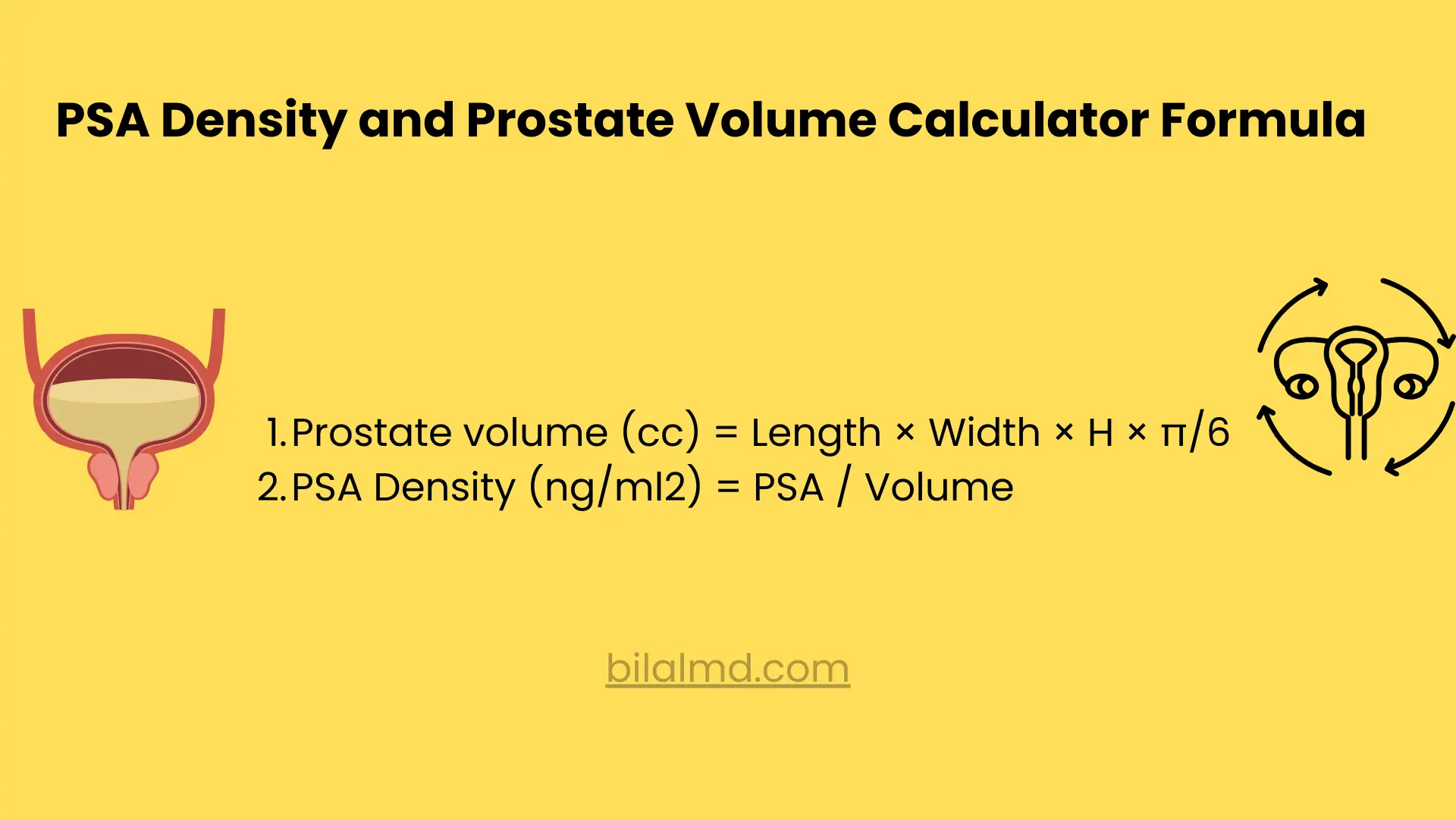
Want a “PSA method calculator”? Most people mean PSA Density (PSAD) PSA divided by prostate volume (cc) which can add context to a raw PSA. To get PSAD you also need gland volume, which you can estimate with a Prostate Volume Calculator (ellipsoid formula).
PSA Method Calculator = PSA Density (PSAD)
- Definition: PSAD = PSA (ng/mL) ÷ prostate volume (cc).
- Why it matters: Adjusts PSA for gland size; often referenced alongside imaging when deciding next steps. (Note: thresholds are guidance, not rules.)
If you already have your ultrasound/MRI dimensions, calculate volume with the ellipsoid formula (L × W × H × 0.52), then compute PSAD. Many urology resources and guidelines discuss using PSAD in context with clinical findings and MRI.
How to Prepare for a PSA Test (Real-World Tips)
Small, temporary PSA bumps can come from common activities. If you’re scheduling a lab draw:
Illness/inflammation matters. Prostatitis, urinary infection, or recent procedures can elevate PSA coordinate timing with your clinician.
Avoid ejaculation for ~48 hours before the test (it can transiently raise PSA).
Consider skipping hard cycling right before testing (some studies show a modest rise immediately after riding).
Understanding a PSA Result (High-level)
- PSA is one input in a broader decision pathway (age, family history, DRE, MRI, risk tools). Authoritative guidelines emphasize shared decision-making and careful interpretation.
- PSA velocity/doubling time: helpful in some follow-up contexts, but not recommended as a stand-alone trigger for biopsy/diagnosis in screening.
- In men with known cancer or during surveillance, shorter PSA doubling time can signal higher risk; longer (≥2 years) is generally more reassuring context still matters.
FAQs People Ask Online
Is my PSA ‘high’ for my age?
PSA varies widely and rises with benign conditions and age. A single number rarely tells the whole story use shared decision-making and consider MRI/PSAD when appropriate.
I had sex before the test can that raise PSA?
Yes. Ejaculation can temporarily increase PSA and may take up to 24–48 hours to return to baseline. Try to avoid ejaculation for two days before testing.
Does cycling right before blood draw change PSA?
It can. Studies show small, short-term increases after cycling, measured within minutes to hours post-ride. If possible, avoid strenuous cycling immediately before your lab.
Should I panic if PSA rose a little since last time?
Not necessarily. Minor variability happens. Guidelines discourage acting on PSA velocity alone; retesting, checking for temporary causes (infection, ejaculation), and clinical context are standard.
What’s PSA density and how do I get it?
PSAD = PSA ÷ prostate volume. If you have an ultrasound/MRI report with 3 dimensions, estimate volume (ellipsoid 0.52 constant) and divide. It’s often used alongside MRI findings.
I’m young and my PSA is under 1 normal?
Age matters, and low PSAs are common in younger men. Any concerns should go to your clinician; many community threads echo this perspective but always confirm with professionals.
PSA density >0.15 is ‘abnormal’ true?
0.15 ng/mL/cc is a classic reference, but modern MRI pathways sometimes use ≥0.20 in MRI-negative men. These are guides; clinicians individualize decisions.
Is DRE enough without PSA?
Evidence suggests DRE alone can miss early cancers; PSA-based strategies and MRI have better detection for significant disease. Use your clinician’s guidance on testing strategy.
“PSA Calculator” vs “PSA Method Calculator” Which Should I Use?
Use the PSA Calculator to record/format your lab value and share it clearly.
Use a PSA method calculator (PSAD) when you also know prostate volume it provides context that PSA alone can’t. Many clinics look at PSA + PSAD + MRI before deciding next steps.