When a pregnancy is at risk for fetal anemia (for example, due to red-cell alloimmunization, fetomaternal hemorrhage, parvovirus B19, or in some twin complications), clinicians monitor the middle cerebral artery peak systolic velocity (MCA-PSV) using Doppler ultrasound. An elevated MCA-PSV expressed as Multiples of the Median (MoM) can flag anemia early and guide timely care. The classic, widely used threshold for significant concern is ≥ 1.5 MoM, though some research suggests a lower cut-off helps detect milder anemia.
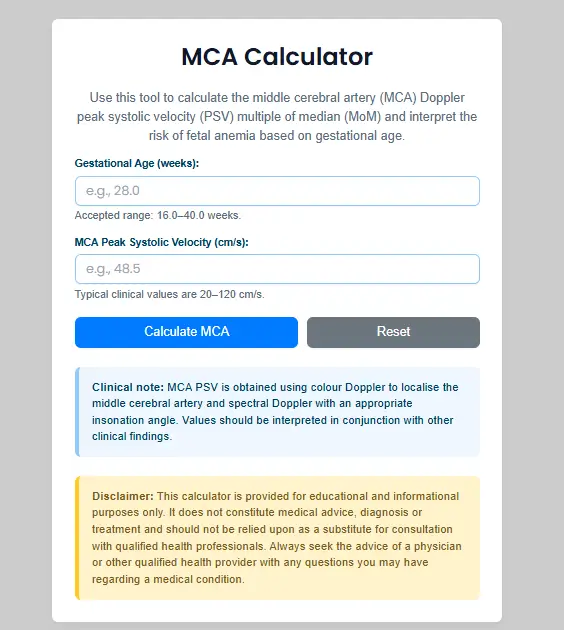
Want to skip the math? Use our free, clinician-informed tool to calculate the median MCA-PSV and MoM instantly: MCA Calculator.
What exactly are MCA-PSV and MoM?
- MCA-PSV is the peak speed of blood flow in the fetal middle cerebral artery measured by Doppler. Anemia lowers blood viscosity and raises cardiac output, which increases this velocity. same gestational age (GA). A value of 1.0 MoM is exactly average for that GA; 1.5 MoM means 50% higher than expected.
The median curve and the formula clinicians use
The expected median MCA-PSV increases with gestational age and has been modeled since the landmark work by Mari et al. The most cited relationship is: Median MCA-PSV (cm/s) = e^(2.31 + 0.046 × GA) (GA in weeks)
This curve underpins MoM calculations in clinical studies and reputable calculators.
If you’d like to double-check your numbers against a peer-reviewed source, see the original NEJM paper and guidance summaries; our calculator implements the same median model.

Which MoM is worrisome?
- ≥ 1.5 MoM is the established cut-off for moderate–severe fetal anemia and often triggers invasive confirmation (cordocentesis) with readiness for intrauterine transfusion (IUT) if indicated.
- Some data suggest ~ 1.29 MoM detects more mild cases (useful earlier in disease), though the 1.5 MoM benchmark remains the standard for moderate–severe anemia.
Important nuances:
- Late gestation (≈ 34–37 weeks): the stand-alone sensitivity of MCA-PSV declines; combining Doppler with signs like hydrops improves detection.
- After transfusions, accuracy falls with each prior IUT; trends and clinical context matter even more.
Who should have MCA Doppler surveillance?
MCA-PSV is recommended in pregnancies at risk of fetal anemia and isn’t a routine test for everyone. Common scenarios include maternal alloimmunization (anti-D and other antibodies), suspected feto-maternal hemorrhage, parvovirus B19, and certain monochorionic twin complications (e.g., TAPS). Authoritative guidance places MCA-PSV at the center of noninvasive anemia screening, replacing older amniotic fluid methods.
How the test is performed (getting a reliable number)
Technique matters. For a valid measurement, sonographers:
- Sample the proximal MCA near its origin from the internal carotid artery
- Keep the Doppler angle at ~0°, avoiding angle correction
- Use an appropriately large sample volume and ensure the fetus is relatively still, minimizing breathing/movement artifacts
These best practices help avoid under- or over-estimation that can change clinical decisions.
Interpreting results across gestation
Because the median rises with GA, clinicians normalize PSV to MoM. A reading of 50 cm/s may be normal at one week but elevated at another; that’s why MoM is the language of decision-making. Our MCA Calculator automatically converts your inputs to MoM using the Mari median model so you can focus on the clinical picture.
👉 Try it now: MCA Calculator compute median and MoM in seconds.
Limitations and when to escalate
- False positives occur for example, after previous transfusions or with technique issues. Persistent ≥ 1.5 MoM typically warrants invasive confirmation in a center with IUT expertise or delivery if safer by gestation.
- Late third trimester: sensitivity reduces; combining Doppler with clinical signs (e.g., hydrops) raises detection.
- Twin pregnancies/TAPS: interpretation can differ; specialized protocols apply.
Bottom line: A single number is less informative than trends plus overall context. Use MoM serially and escalate per guideline-based thresholds.
FAQs: MCA Doppler & MoM
What is a “normal” MCA-PSV or MoM for my week?
There isn’t one fixed speed; it increases with gestational age. That’s why results are expressed as MoM. Around 1.0 MoM means your value is average for that week. Our calculator uses the published median curve to show your MoM.
Is 1.3 MoM dangerous?
1.3 MoM is above average but below the classic 1.5 MoM threshold for moderate–severe anemia. Some studies suggest thresholds near 1.29 MoM may catch milder anemia, so clinicians often look at trends and the bigger picture.
Why is 1.5 MoM such a big deal?
Because ≥ 1.5 MoM correlates with moderate–severe anemia and typically triggers confirmation and planning for intrauterine transfusion (or delivery, depending on GA and risks).
Can an elevated MCA go back to normal?
Yes. Values can fluctuate with fetal activity and measurement conditions. In forum discussions, families often report temporary elevations that later normalize on repeat scans one reason serial monitoring is preferred over one-off readings. (Always follow your specialist’s plan.)
Is MCA Doppler safe for my baby?
It’s noninvasive ultrasound with Doppler; when performed correctly, it’s considered safe and is guideline-endorsed for screening at-risk pregnancies.
Does accuracy change late in pregnancy?
Yes. Between 34–37 weeks, sensitivity drops when using MCA-PSV alone, but improves when combined with other signs such as hydrops. Your team may factor this into decisions about timing delivery versus IUT.
I’ve already had a transfusion will Doppler still help?
It still provides useful information, but false positives rise as the number of prior transfusions increases, so clinicians rely more on trends and the whole clinical picture.
How to use our MCA Calculator (quick steps)
- Enter gestational age (weeks) and measured MCA-PSV (cm/s).
- The tool returns the median for that week, the MoM, and a plain-language interpretation in line with published cut-offs.
- Share or save the result and always discuss with your obstetrician/MFM specialist for decisions.
Key takeaways
- Sensitivity drops after ~35 weeks and post-transfusion, so clinicians use trends and full context.
- MCA-PSV MoM is a powerful, noninvasive screen for fetal anemia in at-risk pregnancies.
- The median model e^(2.31 + 0.046×GA) underlies MoM calculations.
- ≥ 1.5 MoM is the classic threshold for moderate–severe anemia; ~ 1.29 MoM may help detect milder disease.
- Technique matters (near MCA origin, ~0° angle).