You are pregnant or concerned about pregnancy, as you had a miscarriage in the past or someone in your family had. Losing a poor soul is heartbreaking news for Mom. You cannot control it, but you can try to prevent it. We have made a proper guide for moms, I hope you will find it informative.
What is a miscarriage?
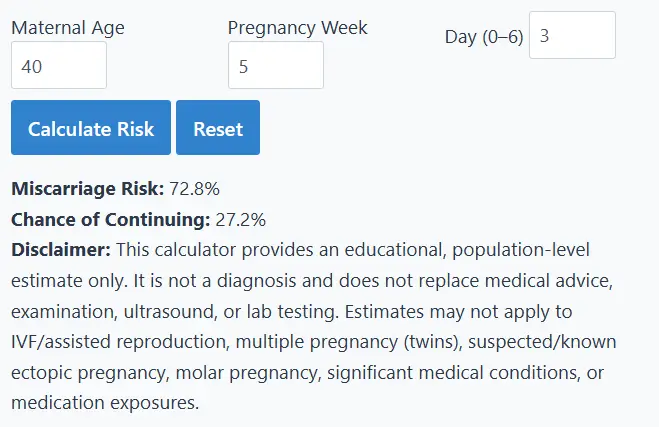
Miscarriage is an early loss of pregnancy before the 20th week of gestation, also known as spontaneous abortion. Most females don’t know they are pregnant or have had a miscarriage, so chances are very high, about 10% to 20% known pregnancies end in miscarriage. So, in short 1st trimester is the scariest part of pregnancy. You can use our miscarriage risk calculator that will help you help to find the risk.
What is your chance of miscarriage during pregnancy?
According to the NHS, about 75 percent of early miscarriage happens in the first trimester, or 12 weeks, or the first three months, or 90 days. The remaining 25% fetal death occurs between 13 and 20 weeks, after that, chances decline. 50% of UK adults said someone they know has experienced baby loss. After 20 weeks of pregnancy, a miscarriage can still happen. 30% to 50% of zygotes die before or during the process of implantation, known as a chemical pregnancy.
Consider the data after the 1st trimester, 3-4 in 100 pregnancies end in miscarriage; we call it late miscarriage. 1 in 80 (1.25%) pregnancies end as ectopic pregnancy, which is a medical emergency, with one side of persistent pain that radiates to the tip of the shoulders, with diarrhea or vomiting.
During pregnancy, if the heart of the fetus is detected on ultrasound miscarriage chances of miscarriage drop around 10%.
Signs and symptoms of miscarriage
If you have the following signs, contact your health care provider;
Bleeding or vagina spotting: 1 in 4 pregnant women find blood spots on their underpants or toilet tissue. Light bleeding is common in the first trimester. If you feel cramping or pain in the pelvic area or lower back, this can be due to pregnancy, or it can be ectopic or molar pregnancy.
Pregnancy loss without hemorrhage: if you face passing of big blood clots or greyish fluid through the vagina.
Abdominal pain: After bleeding, you can face abdominal pain that can be crampy, persistent, mild, or sharp.
If your blood group is Rh negative and your man has not than you need to have an immune globulin injection within 2 or 3 days after you first notice bleeding.
A routine prenatal visit where the doctor is unable to detect the baby’s heartbeat or notices that the uterus is not growing as expected can result in a miscarriage.
Most fetus stops developing before the start of bleeding or cramping.
If you passed tissue from the vagina, keep it in a clean container and bring it to the lab so they can examine signs of a miscarriage
What causes miscarriage?
The exact cause is not known, 50% to 70% miscarriages are because of chromosomal abnormalities. They have genetic data for the baby, like the sex of the baby, hair, eye color, and blood type. An abnormal chromosome is made by either the mother’s bad egg or the father’s bad sperm. The fertilized embryo that developed is not an ideal one, and it will not implant properly in the uterus. After 3 consecutive miscarriage the cause can still be unknown.
Fertilized blighted ovum implants in the uterus begin to develop but embryo either stops developing or doesn’t form at all.
The following are the causes;
- Abnormal blood clots
- Placental abruption
- Preterm labor
- Exposure to lead, arsenic, radiation, or air pollution
- Preexisting diabetes
- Preexisting hypertension
- Thyroid problems
- Severe kidney disease
- Congenital heart disease
- Short and long-term stress
- Recurrent miscarriage
- Group B beta streptococcus infection
- Amniocentesis
- Chorionic villus sampling
- Malnutrition
- Non-steroidal anti-inflammatory medications (NSAIDs) like naproxen and diclofenac, the painkillers, may increase the chances. Isotretinoin is teratogenic and has been linked to fetal abnormalities.
- Premature rupture of the membranes. PROM is when the amniotic sac around the baby breaks before labor starts (water breaks).
- BMI over 30.
- Molar pregnancy, both sets of chromosomes come from the father, triploidy, changes of the placenta that lead to cancer in the pregnant lady.
- Autoimmune disorders. like antiphospholipid syndrome and lupus (systemic lupus erythematosus or SLE). Antiphospholipid syndrome causes blood clots that lead to repeated miscarriages. Your doctor may prescribe you low-dose aspirin to help prevent another miscarriage.
- Hormone issues, like polycystic ovary syndrome (PCOS) and luteal phase defect. A luteal phase defect is characterized by low levels of progesterone in several menstrual cycles.
- Intrauterine fetal demise: an embryo forms but stops developing.
- Anembryonic pregnancy. no embryo forms. Or is absorbed back into the body.
- Getting pregnant while using an intrauterine device (IUD). IUDs are devices placed in your body to prevent pregnancy. In rare cases, people can get pregnant while using an IUD.
Types of miscarriage
- Complete miscarriage: Complete loss of pregnancy, and the uterus becomes empty. Passed the fetal tissue. Confirm complete miscarriage with an ultrasound.
- Incomplete miscarriage: The body doesn’t push all the products of conception out of the body, and the female is bleeding and cramping.
- Missed miscarriage: Loss of pregnancy but don’t know when it happened. Ultrasound confirms there is no cardiac activity.
- Recurrent miscarriage: More than 2 miscarriages in a row, affecting about 1% of couples, and the future also increases.
- Threatened miscarriage: The cervix stays closed or undilated, but you’re experiencing bleeding and pelvic pain. The pregnancy typically continues with no issues, but you should monitor it closely for the rest of the pregnancy.
- Inevitable miscarriage: Cervix has started to open (dilate). You may leak amniotic fluid. A complete miscarriage is likely.
- Asymptomatic miscarriage: Also known as an empty sac pregnancy, possible to have no symptoms like bleeding or cramping, but it may require surgical treatment to remove the tissue.
Risk factors for miscarriage
Here are some risk factors;
- Age
- Obesity
- History of miscarriages
- Uncontrolled gestational diabetes.
- Cervical or uterine or problems
- History of birth defects
- previous miscarriages
- Smoking, drinking, and using drugs
- Exposure to TORCH diseases
- Hormonal imbalances
- Immune system disorders like SLE.
- Parvovirus B19 infection
- Cytomegalovirus
- STIs
- Listeriosis
- CKD
- Congenital heart disease
- Exposure to pesticides; cocaine or high amounts of caffeine
- Diabetes or high blood pressure
- hormonal disorder
- Environmental toxins:
- teratogenic drugs
- Severe malnutrition
- Thyroid disease
- Septic miscarriage
- Lower stomachache
- Foul-smelling fluid called discharge from the vagina.
- Vaginal bleeding.
- Fertility problems
- Clotting disorders
- Septate uterus
- Asherman syndrome
- Fibroids and polyps or scars from previous surgery on the uterus.
- Cervical insufficiency. This is when your cervix opens (dilates) too early during pregnancy, usually without pain or contractions.
- High doses of harmful chemicals or radiation
What does NOT cause miscarriage
Many people think that sex during pregnancy or using birth control pills before pregnancy, exercise, can lead to miscarriage, but that is not true. You should contact your doctor or sports team so they can give you customized plans according to your body.
How painful is a miscarriage?
Miscarriage can be painful or crampy like a menstrual period. A complete miscarriage can be more painful than one who has miscarriage; a surgical procedure is needed to remove it.
Risk of Miscarriage by Week
Weeks 0 to 10 are the high-risk weeks. They can be like a late period. Women realize after 4 weeks of pregnancy. The first sign of pregnancy is a missed period. Most tests detect pregnancy 1-2 weeks after ovulation.
Week 3 to 4
The rate of miscarriage is about 25% to 33% in this time period for all pregnancies. After week 4 risk drops to 15% to 20%. Pregnancy continues to progress, and the risk of miscarriage continues to decline.
Weeks 0 to 6
Women aged between 35 and 39 have a 75% percent increase in risk, and if over 40s it increases 5 times.
Weeks 3 to 5
Most females still don’t know they are pregnant yet. In the 3rd week, implantation occurs, and if a miscarriage happens, it will be known as a biochemical pregnancy or chemical pregnancy.
Weeks 6 to 7
In six weeks, the risk decreases to 9.4%, and at seven weeks it decreases to 4.2%. At 7 week a first-trimester scan is recommended; if a heartbeat is detected, the chances decrease further.
Weeks 8 to 12
After 9 week there is a steep drop in risk that is just 5% and decreases as time passes
Weeks 12 to 20
At week 13, the risk dropped to just 1%, and after the 20th, it became zero. In united states 1% to 5% miscarriages happen between 14 and 19 weeks
Miscarriage After Week 20
After 20 weeks its very rare to give birth or have a miscarriage.
Eat Healthy Foods During Pregnancy
Female should eat healthy foods like;
- Nutritious foods like fruits, vegetables, berries and eggs.
- Dairy products like milk, cheese, and yogurt
- Legumes like beans, peanuts, chickpeas, peas
- Lean meat, like salmon, chicken, and beef. Avoid swordfish, mackerel, bigeye tuna, and shark.
- Whole grains like oats, brown rice, quinoa, and barley
- Water
Take Steps to Avoid Infections in Pregnancy
Take steps to keep yourself and the baby from germs during pregnancy.
- Wash your hands after exposed to germs.
- Avoid people with active infections like common cold, chickenpox, rubella, listeria, parvovirus B19, toxoplasma gondii, rubella, herpes simplex, cytomegalovirus.
- Use bugs repellant to avoid many diseases.
- Avoid cat during pregnancy because they can cause toxoplasmosis
- Eat meat completely cooked because they contain Listeria
Schedule a Pregnancy Appointment
When you get pregnant its really important to go for regular prenatal care. You should not miss regular checkups.
Evaluate Your Current Medications With a Doctor
If you are on medication, discuss with your doctor because some meds can be harmful to your baby during certain trimesters.
Avoid Drinking Alcohol or Smoking While Pregnant
If you have been smoking or drinking, you should avoid it as alcohol can lead to Fetal Alcohol Spectrum Disorders and smoking in early months of life can lead to sudden infant death syndrome,, and in late pregnancy can lead to low birth weight defects.
If you think you’re having a miscarriage
If you notice unusual symptoms like bleeding or cramping during pregnancy, contact your healthcare provider. They can do ultrasound, blood test hormone like hCG and can repeat it in two or three days if you have ectopic pregnancy.
If you come to know an embryo with a normal heartbeat, then your pregnancy is safe. If there is no heart beat that means the embryo did not survive.
In the second trimester, if an ultrasound shows the cervix is shortening or opening, the surgeon can perform cerclage, a procedure in which the cervix is stitched to prevent miscarriage or premature delivery. If you are having bleeding or cramping, just don’t have sex at that time.
Diagnosis and Tests
How is a miscarriage diagnosed?
A miscarriage can be confirmed through an ultrasound, where doctors check for the presence of the fetus’s heartbeat, and through a blood test that measures hCG levels, a hormone produced by the placenta, where low levels may indicate a miscarriage.
A pelvic exam can be performed to check the dilation of the cervix.
A genetic test, such as karyotyping, should be performed to check for chromosome abnormalities, or if you have miscarriage tissue, they can perform a test on it.
The following procedures can be used to see the uterus;
Hysterosalpingogram can be done to see the uterus and fallopian tubes, or Hysteroscopy, a thin telescope-like device is used to see inside the uterus, or Laparoscopy is done to see pelvic organs with a lighted device.
Prevention
Saving your unborn child from dying is prevention.
- Don’t use illegal drugs, alcohol, or cigarettes.
- Take multivitamin daily.
- Maintain weight
- If history of miscarriages, ask for anti-coagulants.
- Have caffeine less than 200 mcg a day
Treatment for miscarriage
Treatment of miscarriage depends on the week the fetus dies. Before 11 weeks doctor can prescribe you some medicine that is a nonsurgical treatment. After 11 weeks, they can do a minor procedure called dilation and curettage, in which they manually take dead baby, which is a surgical treatment.
You will come to the doctor with an empty stomach and fasting for at least 10 hours. Sedation is given through iv and a local anesthetic is used to numb your cervix. A speculum will clean your cervix and vagina with an antiseptic solution and dilate your cervix with narrow metal rods. After that, a hollow plastic tube is used to remove dead fetal tissue from the uterus. A spoon shaped instrument called a curette is used to scrape any dead tissue attached to the uterine walls. The whole procedure can take 15 to 20 minutes.
A dead fetus must be removed from the uterus, as if not removed, it can lead to infection, bleeding, or other complications. After removing all the parts, your miscarriage is complete. No further treatment is needed.
During bleeding, just wear sanitary pads, but no tampons; bleeding and cramping can get worse shortly before the passing of the product of conception. If you missed an abortion and you are wearing a pad, you can see grayish thing on it that is the placenta, fetal tissue with blood clots.
Even in a miscarriage, you will get Rh immune globulin if you have Rh-negative blood and a father’s Rh positive. Avoid having sex, swimming, vaginal medications or using tampons, fingers, or sex toys for at least two weeks after a miscarriage.
FAQs
The chance of having another miscarriage
If you are older than 35 years, then your chances are increased, and the doctor will wait for 3 consecutive miscarriages. If you had a 2nd or early 3rd trimester premature birth due to a weak cervix, then you will be referred to high risk specialist even after a single loss.
Conceiving again after a miscarriage
After a miscarriage, don’t push your body to another pregnancy. Give some time to yourself to become physically and emotionally fit. Your periods will start again in four to six weeks. Tell your man to get a checkup of sperms as over time, the DNA integrity of sperm decreases.
Will I experience a pregnancy loss?
5 in 100 people experience 2 miscarriages in a row, according to the American College of Obstetricians and Gynecologists (ACOG)
Can I get pregnant after I’ve had a miscarriage?
Yes, you can. Miscarriage does not mean you have fertility problems. 87% women have miscarriages and have normal pregnancies and can give birth to a healthy child.