Wondering your conception date is completely normal, especially when you’re planning appointments, tracking pregnancy weeks, or trying to understand your timeline.
A calculator can estimate a likely date or date range using details such as your last period, due date, ultrasound timing, or IVF transfer date.
These results are meant for planning and education, and your clinician may confirm or adjust them using ultrasound.
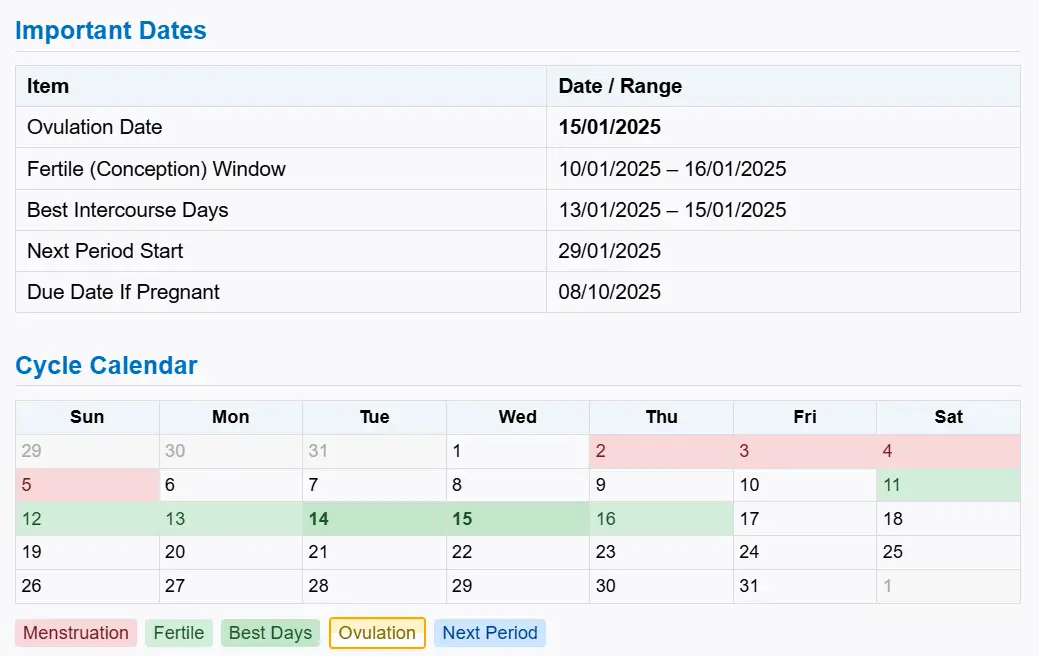
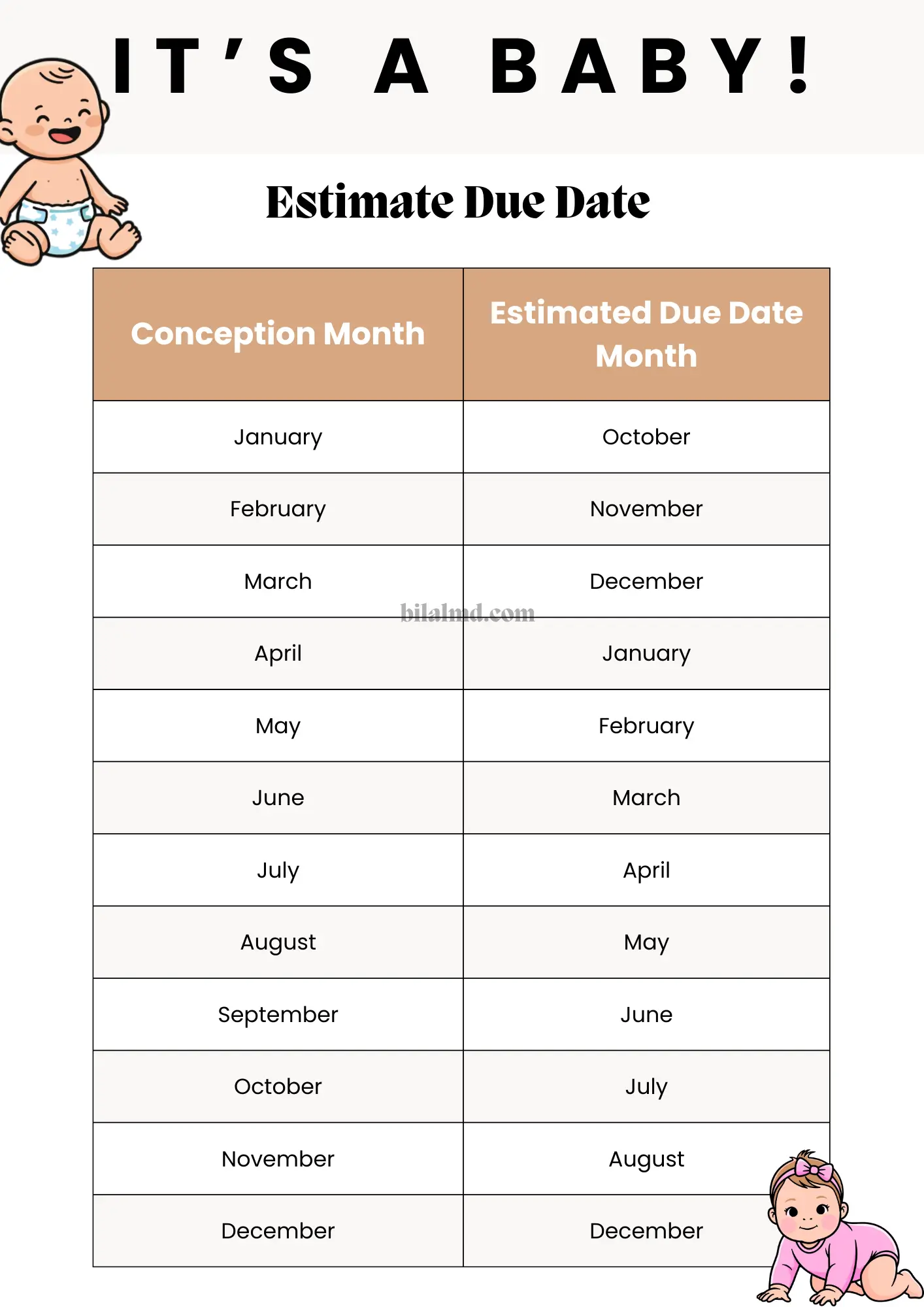
To make pregnancy timing easier to understand, many guides use a conception calendar. This visual approach helps explain how conception timing generally relates to expected delivery months, without relying on exact calculations.
When is your due date?
Your due date (EDD) is an estimate of when delivery might happen.
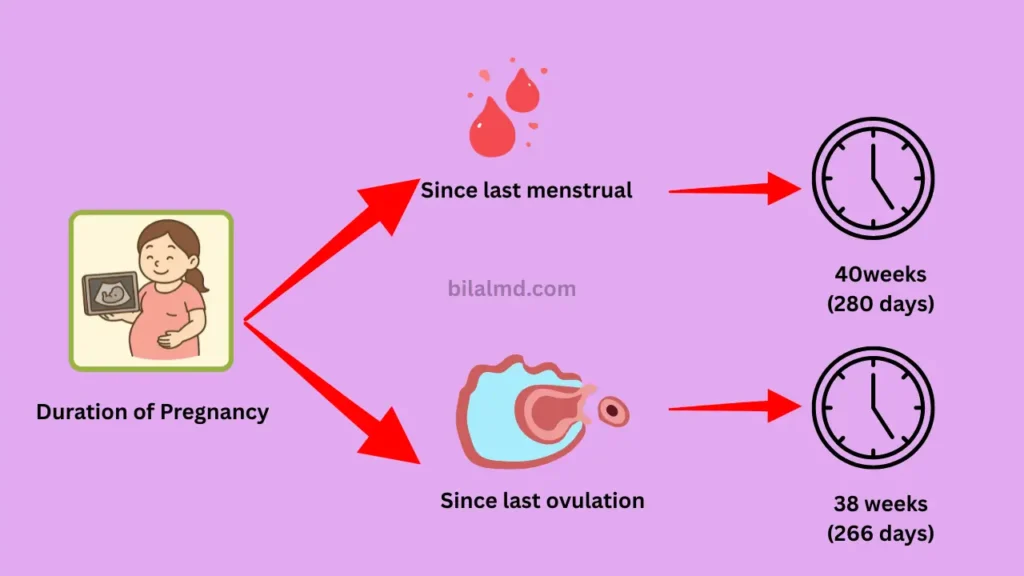
Most calculators start from LMP (last menstrual period) and count 280 days (40 weeks), then adjust if your cycle length is different.
If you already have a confirmed due date from care, use that as your main anchor.
Results are estimates only.
Even strong calculators can’t guarantee an exact day.
Cycle timing varies, ovulation can shift, and early information (like LMP) may be uncertain.
Treat the result as a best-fit estimate, then confirm with your healthcare provider.
How to use BabyCenter’s Pregnancy Date Calculator
Most conception calculators work the same way: you enter one reliable date and the tool does the timeline math.
If you know your due date, the calculator estimates your conception date range by counting backward from the due date.
If you don’t know your due date yet, you can estimate it first using LMP, ultrasound, or IVF transfer timing.
What is your conception date?
Your conception date is when sperm and egg meet and fertilization occurs.
Because timing isn’t always exact, many tools present a window rather than a single moment.
If conception happened through IVF, the timeline is usually easier to estimate because the transfer and embryo age are known.
How is a pregnancy date calculated?
Full honesty: it’s usually impossible to calculate the exact conception moment for natural conception.
That’s because sperm can survive up to several days, while the egg remains viable for a short window after ovulation.
Many calculators assume a “typical” cycle and estimate ovulation around the middle of the cycle, then build the conception date range around that.
Can you determine your due date from your conception date?
Yes. A common approach is: Due date ≈ conception date + 266 days (38 weeks).
But the most common clinical method starts from LMP and counts 280 days (40 weeks).
If you have an early ultrasound, clinicians may use it to confirm or refine dating.
Can your beginning of pregnancy date be “wrong”?
Yes especially if it’s calculated only from LMP or if cycles are irregular.
That doesn’t mean anything is “bad”; it just means the calculator is giving a best estimate based on averages.
For medical decisions, rely on your provider’s confirmed dating plan.
Pregnancy Due Date Calculator
A due date calculator estimates EDD, and many also show pregnancy weeks and milestones.
Some tools let you switch inputs (LMP, conception date, ultrasound, IVF).
This is helpful when you know one date but not the others.
Calculation Method
Choose the method based on what you trust most:
- LMP (most common starting point)
- Ovulation tracking (if you tracked closely)
- Ultrasound (often strong for confirming timing)
- IVF transfer date (often the most precisely timed input)
The first day of your last period
Most pregnancy timelines start here because it’s a date many people know.
The calculator counts forward to estimate the due date and counts back to estimate the conception window.
If your cycle isn’t close to 28 days, the estimate can shift.
Cycle Length
Cycle length matters because ovulation doesn’t always happen on “day 14” for everyone.
Some tools allow cycle length ranges (often 21–35 days) and adjust the window accordingly.
If you’re unsure, use the average, then confirm with clinical dating if available.
Calculate My Due Date
Once you enter your method and date, the calculator provides:
- estimated due date
- estimated conception date (or range)
- ovulation/fertile window estimates
Use this as a planning guide, not a fixed deadline.
Want to know your conception date?
If you already know your due date (from care or a reliable estimate), work backward.
That’s why “due date → conception date” calculators are popular for people who want the likely start point of pregnancy.
You’ll usually get a range, not one exact day.
How to Calculate Your Due Date
Here are the common routes calculators use:
- LMP + 280 days
- Conception date + 266 days
- Ultrasound dating (especially helpful when LMP is uncertain)
- IVF transfer formulas (based on embryo age at transfer)
What is an estimated due date during pregnancy?
An estimated due date is a calculated prediction of when your baby might arrive.
It helps plan prenatal visits, screening windows, and trimester milestones.
It’s an estimate, not a guaranteed delivery day.
First day of the last period
This method is simple and widely used, but it assumes ovulation timing that may not fit everyone.
If your cycles are irregular, dating can be less precise with LMP alone.
That’s where ultrasound confirmation can help.
Conception date
If you tracked ovulation or know conception timing, you can estimate due date by adding ~266 days.
This can be useful for clearer timelines, especially with reliable tracking.
Still, confirm with your provider when possible.
IVF transfer date
IVF dating often uses embryo age at transfer.
A practical rule is transfer date + (266 − embryo age in days), which yields the common day-3/day-5 transfer offsets.
This is why IVF timelines can be a strong anchor for dating.
Ultrasound scan
If you can’t pinpoint LMP, ovulation, or conception, an early ultrasound can help estimate gestational age.
Some providers routinely do early scans; others do them when dates are unclear or cycles vary.
Follow your clinician’s guidance for what applies to you.
Can I plan my due date?
You can try to influence timing by tracking your fertile window and planning conception attempts.
But you still can’t reliably plan the exact delivery day, week, or even month with certainty.
Use tools to understand your fertile days, then keep expectations flexible.
Can my due date change?
Yes. Your provider may update your due date if later information suggests a different dating is more reliable.
Large discrepancies between LMP estimates and ultrasound timing can trigger redating rules.
If you’re unsure, ask what dating method your care team is using.
Pregnancy Due Date & Gestational Age Calculator
Some calculators also show gestational age “today” and key date windows.
This is useful if you’re asking, “How many weeks pregnant am I right now?”
It’s also helpful for aligning your timeline with appointment schedules.
Results
Your results typically include an EDD and a conception date range.
Some tools also show estimated ovulation, “best days,” and next period estimates.
Use these as guidance, not guarantees.
Important dates & windows
The fertile window usually includes the five days before ovulation and the day of ovulation.
That’s why conception calculators often highlight a multi-day range.
This helps users understand why “one exact day” is hard to confirm.
Gestational age on a given date
If you want to know “How far along was I on this date?”, use gestational-age-by-date features.
This can help when you’re matching dates to appointments or tests.
It’s also useful for documenting timelines.
Determining the Date of Conception
Best-case accuracy comes from known timing (IVF) or early ultrasound confirmation.
Without that, the estimate comes from cycle patterns and probability.
That’s why calculators output “most likely” and “possible” ranges.
Determining the Estimated Due Date
Clinical guidance supports standardized dating approaches and careful documentation.
If an ultrasound confirms or revises your EDD early, that date often becomes the main reference point.
Ask your provider which date they want you to use.
When to Prefer Ultrasound Dating Over LMP (ACOG/AIUM/SMFM Committee Opinion No. 700)
Redating thresholds depend on gestational age and the size of the discrepancy.
This is why an early ultrasound can be so useful when LMP is uncertain.
It helps reduce timing errors in care planning.
Other Methods for Estimating Gestational Age
Some resources also mention other inputs used clinically.
These are supportive signals, not replacements for dating rules.
Your clinician will choose what fits your situation.
Clinical Examination
A physical exam can provide clues, especially later, but it’s not the most precise method alone.
Doppler Ultrasonography
Doppler is used in pregnancy care, but dating is typically based on standard ultrasound measurements and rules.
Human Chorionic Gonadotropin (hCG)
hCG trends can support early pregnancy assessment, but they don’t replace dating confirmation.
Twins
Multiple pregnancies can follow different growth patterns and delivery timing expectations.
Observed Gestational Age at Delivery by Plurality
Some references summarize delivery timing patterns by singleton vs multiples.
Due Date Calculator
If you want a quick way to estimate EDD based on multiple inputs, due date calculators are built for that.
They’re especially helpful when you’re choosing between LMP, conception date, ultrasound, or IVF inputs.
Use the method that matches your most reliable information.
Estimation of due date
It can help to treat due date as a range, not a single day.
This reduces stress and better matches real-world delivery timing.
Your provider can tell you what “normal range” means for your pregnancy.
Last menstrual period
This is the most common input and works well when cycles are predictable.
If cycles vary, the estimate may be less accurate.
That’s when ultrasound confirmation becomes more important.
Ultrasound
Ultrasound can help confirm gestational age, especially in the first trimester.
Many providers use it to confirm or adjust the due date when needed.
Follow your clinic’s advice for timing and interpretation.
In vitro fertilization (IVF)
IVF dating uses known transfer timing and embryo age to estimate due date.
This often provides a tight timeline compared with estimates based only on LMP.
Still, all due dates remain “estimated” in real life.
Due Date Calculator
Your health care provider will confirm gestational age with care-based methods, often including first trimester ultrasound.
Online calculators are best used as a starting point.
For medical decisions, rely on your provider’s confirmed dates.
WHEN DID I CONCEIVE? CALCULATE YOUR DATE
If your main question is “When did this start?”, a conception date estimate gives you clarity.
Use it for understanding your timeline and preparing questions for your appointment.
If you need certainty for clinical decisions, ask about a dating ultrasound.
Pregnancy Due Date Calculator & Conception Calculator
Some pages combine both tools because people often want both answers: conception date and due date.
That’s also why the BilalMD calculator experience should show both outputs clearly.
A combined output improves user satisfaction and reduces confusion.
What Date Did I Conceive?
You usually can’t pinpoint one exact day without tracked ovulation/IVF.
But you can estimate a likely window using LMP, cycle length, and the fertile window concept.
That’s typically accurate enough for planning and understanding.
Pregnancy Date Calculator
If doing the math manually feels annoying, a calculator is the easiest route.
It turns one trusted date into a full timeline.
That’s the main value: fast clarity.