
Conception Calculator
You want to get pregnant or have sex with more than one partner, and want to know who the father is. You just need to know your last period 1st day and the exact date of intimation with both men. As sperm can live upto 5 days. If you had sex with another men in ovulation period, then chances are high he made you pregnant.
If you deliver your baby today wanted to know when you conceived. You can just subtract 266 days from today, which is the day you may have conceived. If you want help, you just simply put data in conception calculator and find your answer:
This page explains how the calculator works, which method to use, how accurate your estimate is, and what to do next.
Curious to Know Your Estimated Due Date?
Your estimated due date (EDD) is commonly calculated from your last menstrual period (LMP) using a “40-week” (280-day) model, then adjusted if your cycle is shorter or longer, or if an early ultrasound gives a more reliable date.
Pregnancy Calendar and Due Date Calculator
A good conception calculator doesn’t just output a single day; it gives you a range and a timeline, because real-life biology varies.
Your results may include:
- Estimated due date (EDD)
- Estimated conception date (or conception date range)
- Gestational age (how far along you are)
- Key milestones (end of trimester windows, etc.)
When Did I Conceive?
Even if you remember the exact day you had sex, conception may not match that day because:
- Sperm can survive up to ~5 days in the female reproductive tract in the right conditions.
- The egg is typically viable for about 12–24 hours after ovulation.
If you had sex with more than 1 partner, but there is a difference of more than 5 days, then you can identify the father of the baby.
That’s why many tools estimate a fertile window (a few days) rather than a single “conception moment.”
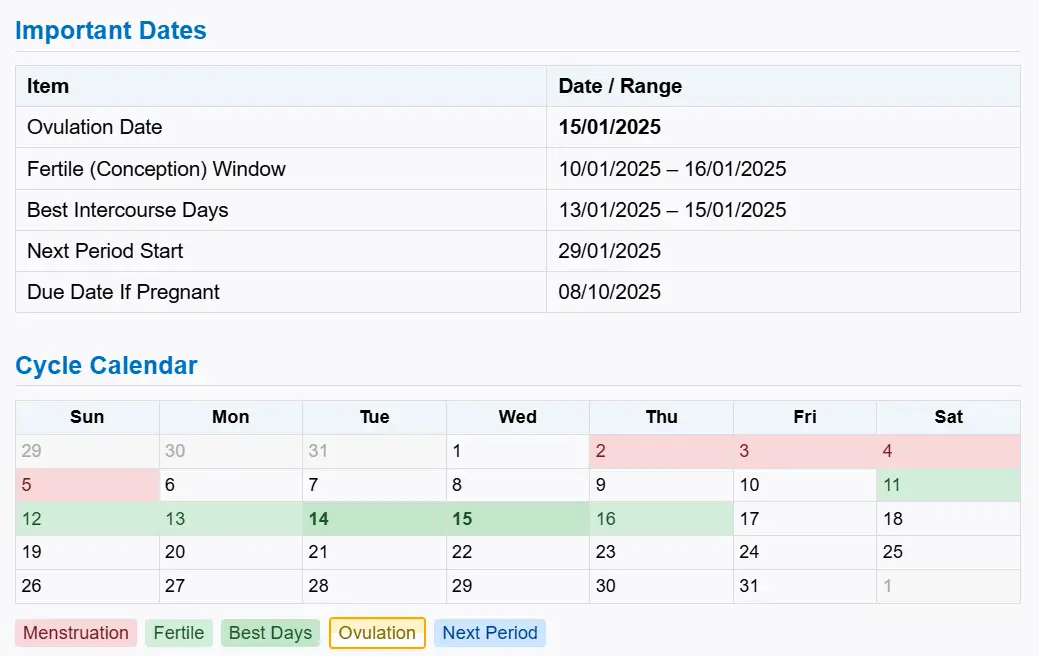
How to Know When You Conceived
No method is perfect, but some are more reliable depending on what you know.
Ovulation
If you tracked ovulation (OPKs, temperature, cervical mucus, app + symptoms), conception typically happens around ovulation. However, ovulation timing can shift even in people with “regular” cycles, so this method is best when you track closely.
Intercourse
Using intercourse alone is less exact because sperm can live several days, and timing relative to ovulation matters most.
Ultrasound
Early ultrasound is often used to confirm or refine pregnancy dating, especially when cycles are irregular or LMP is uncertain. Clinical guidance supports standardized dating approaches and ultrasound-based adjustments when appropriate.
How Does the Pregnancy Due Date Calculator Work?
Most calculators ask for one of these starting points:
- First day of your last period (LMP)
- Date you conceived (if known)
- Ultrasound date + gestational age at the time
- IVF transfer date (plus embryo age)
Then they estimate:
- Due date (EDD)
- Conception date (often by counting back)
- Gestational age (how many weeks/days pregnant)
A common reference point is that pregnancy is about 40 weeks from LMP, but the “baby’s age” from conception is closer to 38 weeks because LMP-based dating starts ~2 weeks earlier than ovulation in a typical cycle.
How Can My Estimated Due Date Be Calculated?
Last Menstrual Period (LMP)
This is the most common method: EDD ≈ LMP + 280 days (40 weeks), assuming a typical cycle and ovulation timing.
Conception Date
If you know the conception (or ovulation) date, many tools use EDD ≈ conception + 266 days.
IVF Transfer Date Method
IVF dating can be more precise because the transfer date and embryo age are known; calculators typically derive conception timing from embryo age and then add ~266 days for EDD.
Ultrasound Scan
Ultrasound-based dating compares fetal size with expected growth patterns. Early scans are commonly used to confirm or adjust dates when LMP is uncertain or cycles vary.
Estimation of due date
Last menstrual period
Useful and widely used, but less reliable if you have irregular cycles, recently stopped hormonal contraception, or don’t recall dates accurately.
Ultrasound
Often used to improve dating accuracy, especially earlier in pregnancy.
Conception date
Helpful if you tracked ovulation or used fertility treatment, but still commonly handled as a range, not a single day, because timing can vary.
In vitro fertilization (IVF)
Generally gives a tighter estimate because dates are known.
Determining the Date of Conception
A “conception date” is usually treated as the date of ovulation/fertilization, but biologically, the process involves multiple steps and timing uncertainty. Because the egg’s fertilization window is short (12–24 hours) while sperm may survive days, most calculators output a conception window.
Your due date is only an estimate
Even with great inputs, an EDD is still an estimate. Full-term pregnancy commonly falls in a range (often described as roughly 37–42 weeks), and many births happen before or after the “exact” due date.
How Accurate is My Pregnancy Due Date?
Accuracy depends on:
- How sure your LMP date is
- Your cycle length variability
- Whether ovulation was early/late
- Whether an early ultrasound was done
- IVF vs non-IVF conception
Standard clinical guidance supports using consistent dating rules and refining dates when better information becomes available (like early ultrasound).
Can My Due Date Change?
Yes. If early ultrasound dating suggests a different timeline (or if LMP is uncertain), providers may adjust your due date.
Calculate Forward / Calculate Backward
Some calculators let you:
- Calculate forward: Start from LMP → estimate due date and milestones
- Calculate backward: Start from due date → estimate conception range and LMP
This is useful if you were given a due date at a visit and want to understand the implied conception window.
Results
A results panel can show more than just one date.
Each due date report contains the following data:
Examples of what many tools include:
- Estimated due date
- Estimated conception date
- Trimester stages / weekly progression
- Milestone timing
Important dates & windows
Depending on the calculator, you may also see:
- Estimated date of conception
- End of 1st trimester (12 weeks)
- End of 2nd trimester (27 weeks)
- Other planning milestones
What is an Estimated Due Date?
An estimated due date (EDD) is a prediction of when your baby might be born. It’s based on typical pregnancy timelines (like 40 weeks from your last period) and may be adjusted with clinical information such as ultrasound measurements. Doctors and caregivers use it to schedule checkups, important tests, and track your pregnancy progress.
Which Calculation Method Should I Use?
Use the method that matches what you know best:
- Know your LMP + cycle length? Start with LMP.
- Tracked ovulation or know conception? Use conception date (or ovulation date).
- Had an early ultrasound? Use ultrasound dating if that’s what your clinician confirmed.
- IVF transfer? Use IVF transfer date + embryo age.
What About with IVF?
IVF timing is often more exact, but your clinic’s confirmed dates should be treated as the source of truth for medical planning.
What If I Already Know My Due Date?
If you already have a due date (from a scan or clinician), you can still use a conception calculator to:
- estimate your conception window,
- understand gestational age today,
- map trimester milestones and planning dates.
What is my due date or baby’s birthday?
If you’re starting from LMP, the classic approach adds 280 days (40 weeks) to the first day of your last period, then adjusts based on cycle length when needed.
Now That I Have My Estimated Due Date, What Next?
Practical next steps:
- Book your first prenatal appointment (or confirm with a qualified clinician).
- If you don’t know your LMP or your cycle is irregular, ask about dating ultrasound.
- Use your timeline to plan for key screening windows and trimester milestones.